
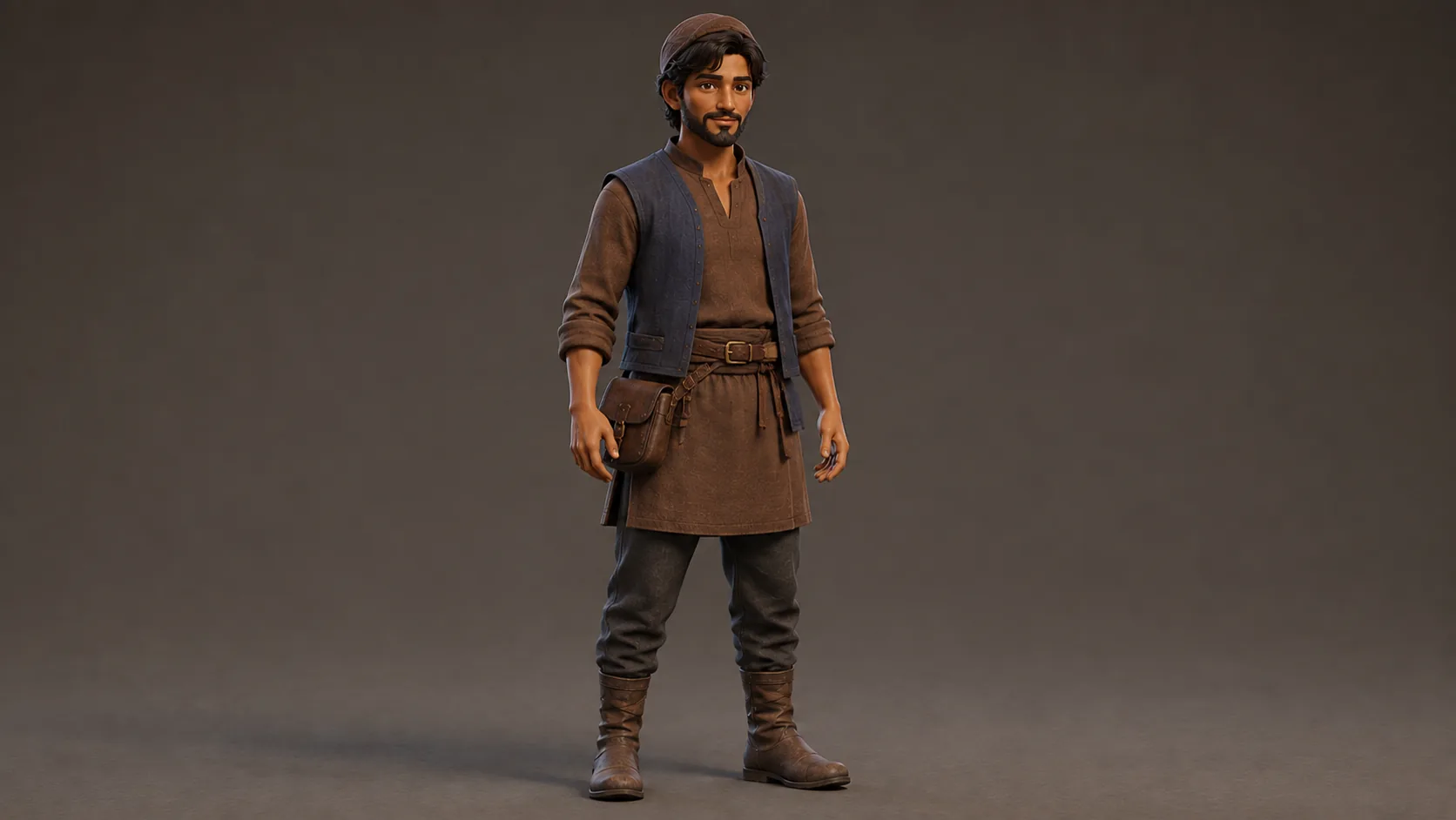
Answer in brief
Umro Ayyar is the principal strategist of MUD’s Dastan-e-Ameer Hamza universe. His ayyari combines disguise, observation, infiltration, timing, evidence and escape in service of a larger mission; it is disciplined intelligence, not cleverness without consequence.
A strategist who enters through the overlooked door
When a trap appears complete, Umro looks for the assumption holding it together. Perhaps the guards believe a uniform is an identity. Perhaps a ledger is trusted because nobody checks who altered it. Perhaps everyone watches the main gate while a servant’s route remains invisible. Umro’s gift is not simply finding a hidden passage. It is finding the belief that made the passage hidden.
Across versions of the tradition, his name appears in forms including Umro, Amar and Amr Ayyar. MUD uses Umro Ayyar and builds his presence around a clear promise: by the time the trap closes, he has already left an answer inside it.
What does ayyari mean in MUD’s story world?
Ayyari is a practice of strategic movement through hostile systems. It brings together disguise, observation, infiltration, misdirection, tool use, timing, evidence and escape. Each skill matters, but the combination matters more.
A disguise without observation is a costume. Infiltration without an exit is a delay. Escape without evidence may save one person while leaving the lie intact.
That final point is essential. MUD’s Umro does not treat cleverness as a licence to do anything. The route matters, but so does what remains after he has gone: a witness protected, a record recovered, a false claim exposed or a mechanism made visible.
Why disguise is not the punchline
Disguise can be funny, tense or astonishing, but it should never flatten ayyari into comic dress-up. A successful disguise changes social access. It lets Umro cross a boundary because the people controlling that boundary see what they expect to see. The scene therefore depends on behaviour as much as fabric: posture, vocabulary, pace, confidence, eye contact and knowledge of the room.
Animation makes those details visible. A hand hesitating over the wrong seal can be more dangerous than a sword. A guard looking half a second too long can tell us the disguise is failing. The audience should enjoy the transformation while also understanding the intelligence that sustains it.
Evidence is the difference between escape and victory
Many adventure stories end the moment the hero gets out. Umro asks what the escape proves. If a corrupt order remains in the archive, the next prisoner may face the same danger. If a stolen name is not restored, freedom can still be denied in public. Evidence lets an individual act become a civic consequence.
That is why objects matter around Umro: keys, seals, ledgers, routes, altered entries and items that can be compared. These are not decorative props. They are parts of an argument. Ayyari turns the environment into testimony.
How to watch an Umro scene
First, notice what the camera lets him see. Second, notice what he touches—and what he deliberately leaves untouched. Third, look for the exit before the scene announces it. Finally, ask what proof survives. The pleasure of ayyari is not only being surprised by the answer. It is realizing that the answer was present in the scene all along.
Frequently asked questions
Is Umro Ayyar only comic relief?
No. Humour may be one of his tools, but MUD treats him as a serious strategist whose choices affect evidence, safety and public truth.
Is ayyari magic?
In MUD’s character language, ayyari is primarily a disciplined combination of observation, disguise, infiltration, tools, timing and escape. Fantastical worlds may surround it, but Umro’s intelligence must remain readable.
Why are there different spellings of his name?
The stories have travelled through different languages, scripts and editions. Umro, Amar and Amr are common transliterations; the MUD website uses Umro Ayyar consistently.