
Answer in brief
Dastan-e-Ameer Hamza is a vast heroic prose-romance tradition carried through oral storytelling, manuscripts and print across Persianate and South Asian cultures. MUD Productions is developing a cinematic Urdu animated adaptation as a planned ten-book journey beginning with Badshah ka Khwaab.
A story too large for a single doorway
Some stories arrive as one novel with one fixed beginning. Dastan-e-Ameer Hamza arrives more like a city: through many gates, told and retold by different voices, enlarged by performance, memory and place. Historical references use names including Hamzanama and Dastan-e-Amir Hamza. The spellings vary because the tradition has travelled through languages, scripts and publishing histories; the central invitation remains the same—enter a world of heroic trials, improbable journeys, loyalty, strategy and wonder.
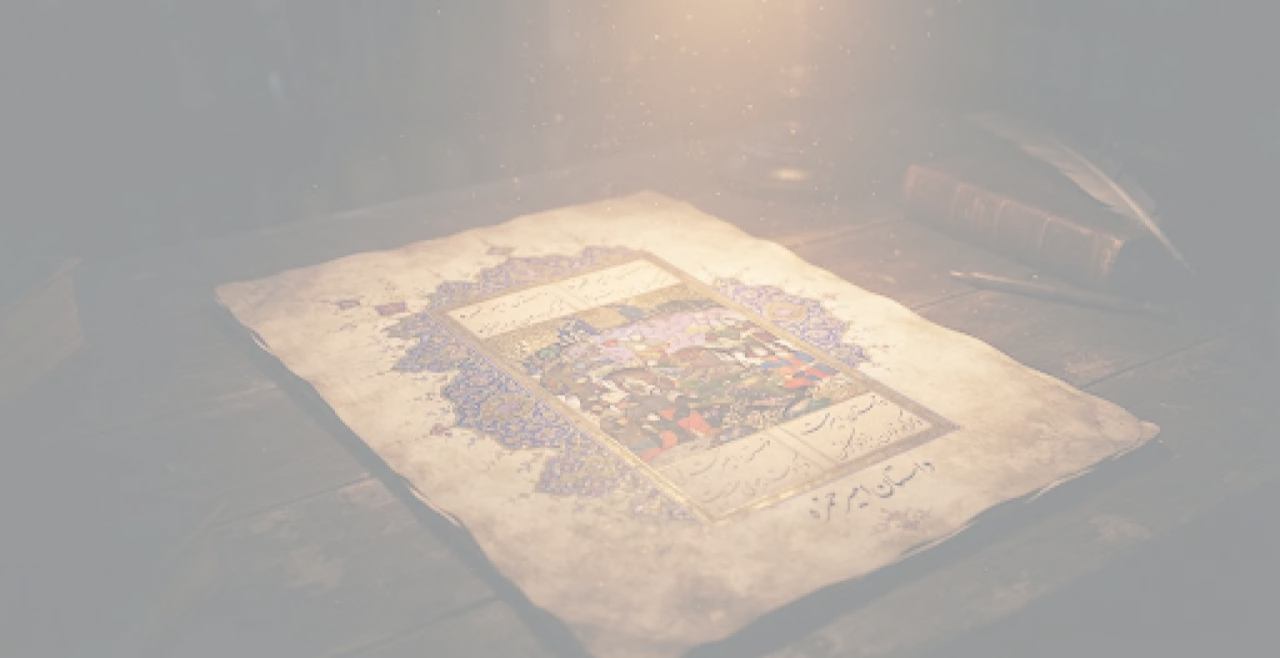
The legendary hero is associated with Hamza, uncle of the Prophet Muhammad, but the dastan grew far beyond a compact biography. It became an expansive romance in which courts, battlefields, enchanted spaces, disguises, rivalries and friendships could hold an audience over many sittings. Museum collections preserve spectacular pages from Emperor Akbar’s illustrated Hamzanama, while literary scholarship records a much wider oral and written life. No single image or volume contains the whole tradition.
What should a new viewer expect?
Expect adventure, but do not expect action without consequence. In MUD’s interpretation, strength has to answer to judgment, cleverness has to leave evidence, and inheritance has to be proved through conduct. A locked door is therefore not only an obstacle. It may be a question about permission. A crown is not only decoration. It may be a test of whether authority can survive public truth.
The world is fantastical, yet its emotional logic is human. Characters must decide whom to protect, when to listen, what proof to preserve and which route will keep another person safe. That is where spectacle becomes story.
Meet the central trio
Ameer Hamza stands at the centre, but heroism is not treated as a solo performance. Hamza’s disciplined courage gains meaning through protection and restraint. Umro Ayyar reads rooms, disguises, routes and evidence. Muqbil notices the small mechanism that controls a much larger danger. Together they create three different kinds of attention: moral, strategic and precise.
Watch what each man notices before he acts. Hamza often reads the human cost. Umro reads the system around the trap. Muqbil reads the physical detail everyone else has missed. Their friendship lets the story move between force, intelligence and exact observation without pretending that one talent can solve every problem.
How MUD is structuring the journey
MUD’s adaptation is planned as a ten-book animated journey beginning with Badshah ka Khwaab and expanding toward Tilism-e-Hoshruba. The public story world moves through five principal realms: Nadir, Madain, Purisrar Jazeera, Koh-e-Qaaf and Ayyar Fort. Each world has a dramatic rule, not merely a visual skin.
The project is rooted in Urdu dialogue with English subtitles, making language part of the performance rather than an ornamental label. The cinematic design follows the same principle. Costumes, distances, doors, objects, injuries, light and time retain state from scene to scene. If a choice changes the world, the world must remember it.
The best way to begin
You do not need to study every branch of the tradition before watching. Begin with the official trailer, then choose one doorway: a character, a world or an artifact. Read the short answer first. Explore the deeper production note if something catches you. The website is designed as an archive that opens gradually, not an examination you must pass.
Most importantly, watch conduct. Who listens? Who records? Who leaves an exit? Who treats another person’s warning as evidence? Dastan-e-Ameer Hamza may be full of marvels, but the choices are what make it legible—and memorable.
Frequently asked questions
Is Dastan-e-Ameer Hamza the same as the Hamzanama?
Hamzanama is one widely used historical name for the tales of Hamza, including the famous illustrated Mughal manuscript. Dastan-e-Ameer Hamza names the broader storytelling tradition and is the title used for MUD’s adaptation.
Do I need to know Urdu to follow MUD’s series?
No. The project is rooted in Urdu performance and is designed with English subtitles and clear visual storytelling so viewers can follow the action, decisions and world rules.
Where should a first-time viewer start?
Start with the official trailer or the Dastan-e-Ameer Hamza series guide, then explore the profiles for Ameer Hamza, Umro Ayyar and Muqbil.