
Answer in brief
Koh-e-Qaaf’s temporal rule gives the travellers three experienced days while eighteen years pass elsewhere. MUD visualizes that difference through two coherent clocks: the travellers retain short-term continuity, while people, places, relationships and institutions outside the realm carry long-term change.
Two clocks must both be true
Altered time fails when it is treated as a surprise number added at the end. The traveller’s experience must remain continuous: clothing, supplies, fatigue, memory and unfinished conversations belong to three days. The returning world must carry eighteen years: age, absence, changed authority, altered use of space and consequences that had time to harden. Neither clock cancels the other. The emotional force comes from their collision. A character may feel that a promise was made three mornings ago while the person who received it has lived nearly two decades with the silence.
Show duration before anyone explains it
The first proof of elapsed time should not depend entirely on dialogue. A familiar route may have a new purpose. A structure may have been repaired, expanded, abandoned or renamed. A child may now occupy an adult role. Objects that were temporary may have become institutions; decisions that felt reversible may have become history. Visual evidence lets the audience discover the scale of change alongside the characters. Exposition can confirm the rule, but the world should already have testified.
Protect the travellers’ short time
Inside Koh-e-Qaaf, continuity needs its own discipline. Three days still contain light cycles, rest, hunger, movement and cause. If the realm feels like an unmeasured dream, the contrast loses weight. We track what each character knows at entry, what changes during the three days and what remains unresolved at exit. This short-clock ledger prevents the magical rule from becoming a shortcut. Time can be altered without becoming arbitrary.
Make the return relational
Eighteen years are not communicated by adding wear to a wall. They live in people. Loyalty may have changed form. Grief may have acquired ritual. A vacant position may now belong to someone who has never known the old order. The returning characters cannot simply resume their places because the world has continued making decisions without them. That is the heart of the rule: time becomes a moral distance. The question is not only what has changed, but what the travellers owe to a world that had to continue.
Editing the threshold
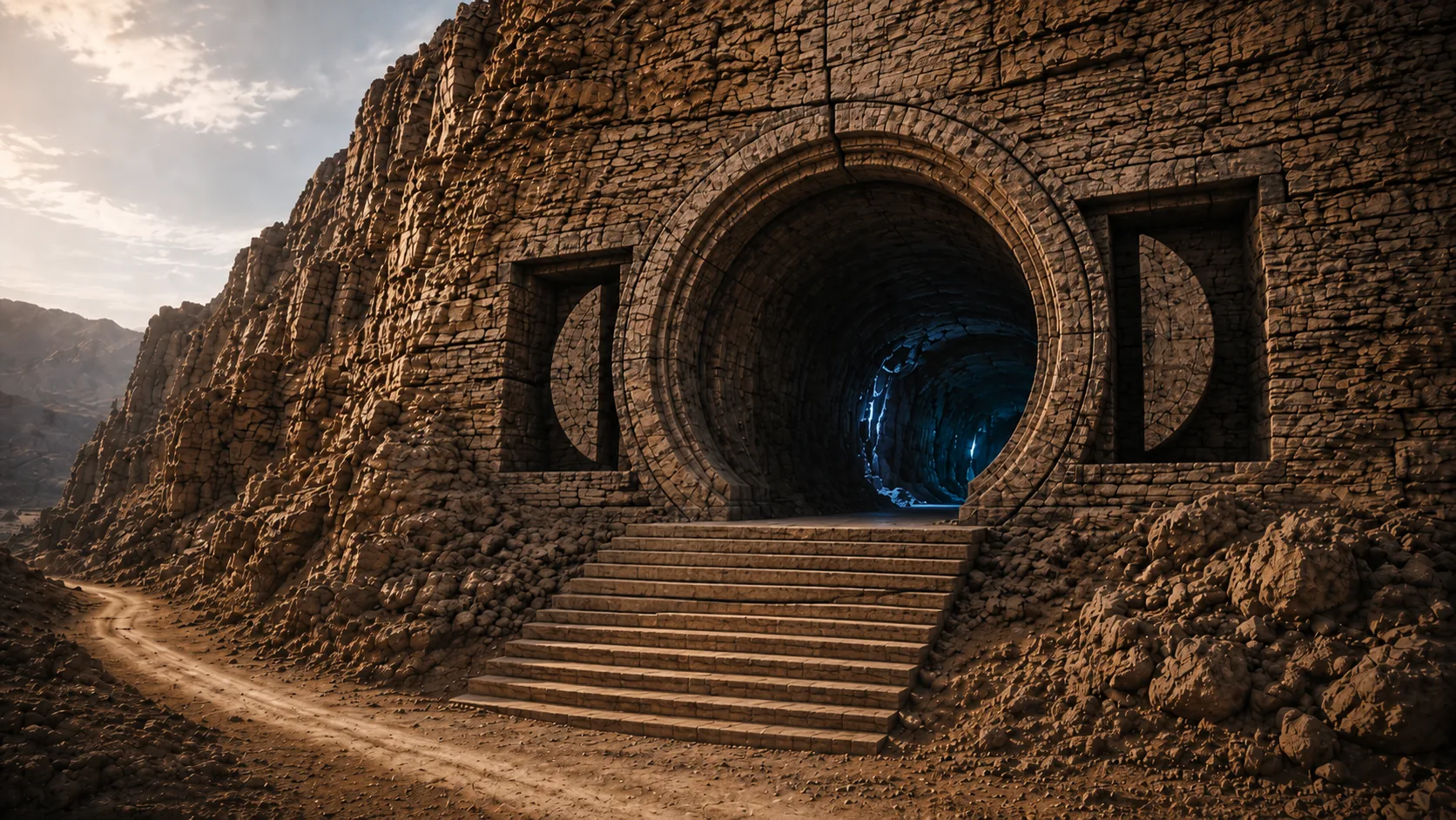
The transition into and out of Koh-e-Qaaf should use a repeatable visual grammar. Direction, sound, light and a small set of anchor details can tell the audience that a temporal boundary is being crossed. The grammar should be recognizable without becoming a mechanical portal effect. On the return, matching compositions can make change legible: the same camera position, a different use of the space; the same doorway, a different generation passing through it. Altered time becomes most powerful when the comparison is exact.
Frequently asked questions
Does three days always equal eighteen years in every MUD world?
No. This is the approved temporal rule associated with Koh-e-Qaaf, not a universal rule for every location.
Why show time through places as well as people?
Places preserve public change—new uses, repaired damage, altered access—while people carry private memory and relationship. Both are needed to make eighteen years credible.
How do you stop magical time from feeling random?
Define both clocks, track state on each side of the threshold and make every visible change traceable to elapsed time or story action.