
Answer in brief
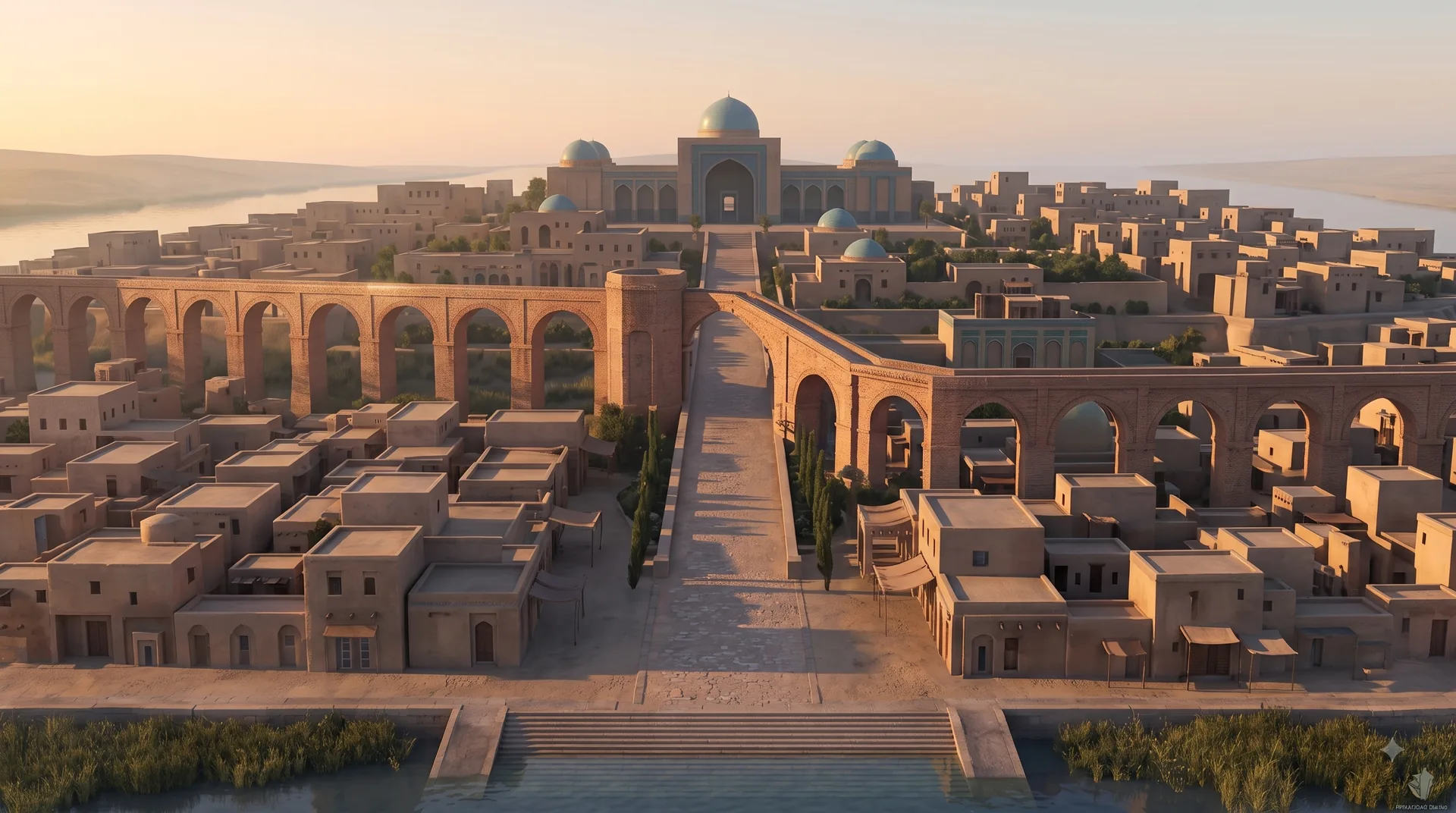
Civic geography matters in Madain because every claim must move through physical space. The bazaar, palace court, observatory, homes, river edge, Bakht Jamal’s House and Seven-Door Vault determine who sees an event, who records it and whether truth can reach authority.
A city built from consequences
We do not begin a Madain map by asking where a beautiful tower should stand. We begin by asking what must happen between a citizen’s experience and a royal decision. Where is a petition first heard? Which road connects a crowded market to the palace? Can news from the river reach the court before an official record is changed? Geography gives each answer a cost in time, distance and visibility.
This makes the city legible as a civic system. A viewer may never memorize the plan, yet repeated routes build intuition. The audience learns whether the court feels close to daily life or insulated from it, whether the observatory watches the same sky as the bazaar, and whether a private home can become a place where public truth begins.
Five spaces, five kinds of authority
The bazaar holds public memory. It is crowded, conversational and difficult to control completely. The palace court formalizes claims: who may speak, what counts as proof and which language authority recognizes. The observatory represents disciplined interpretation, where signs must be read rather than merely feared. Homes reveal what policy feels like at human scale. The river edge brings movement, trade, risk and arrival into the city’s logic.
Bakht Jamal’s House and the Seven-Door Vault add sharper questions. A house can protect testimony—or isolate it. A vault can preserve knowledge—or turn access into power. Their meaning depends on how they connect to the rest of Madain, not on how impressive they look in isolation.
Why distance is a story rule
If a character crosses from the river to the palace in one scene, that journey establishes a duration. If the same trip becomes instantaneous later without explanation, the city loses credibility. The same is true of doors, stairs, courtyards and sightlines. A witness cannot see around a wall that previously blocked the view. A crowd cannot arrive before the route allows it.
Continuity therefore begins with geography. We track the direction of travel, the order of thresholds and the time a route should take. Those limits do not restrict drama; they generate it. Delay can create danger. A visible balcony can create accountability. A narrow entrance can change who reaches a hearing first.
Civic scale makes fantasy personal
A palace tells us how power imagines itself. A home tells us what that power does to a family. A market tells us what people repeat when officials are not present. Moving between these scales prevents the world from becoming a sequence of monumental sets.
It also lets the audience measure justice. If a decision made in the court changes the bazaar, we should eventually feel that change in sound, movement and behaviour. If a record disappears into the vault, we should understand who loses access. Madain remembers policy through space.
Designing the map for exploration
On the website, Madain should open as a readable map before it becomes a 3D spectacle. Visitors can follow routes between the bazaar, court, observatory, homes and river, then inspect production notes about distance, evidence and continuity. Motion should reveal relationships, not hide them.
The goal is simple: when the audience returns to Madain, the city should feel like somewhere events have already happened. A door remembers who passed through it. A square remembers who witnessed a claim. Geography becomes the archive of consequence.
Frequently asked questions
Is Madain presented as a real-world travel location?
No. This article describes Madain as MUD’s story-world geography and production system, not as a modern travel guide.
Why map interiors as carefully as streets?
Interior thresholds decide access, visibility and timing. A vault door, court entrance or house corridor can control evidence as strongly as a city gate.
How does the map help continuity?
It gives writers, layout artists, animators and editors one shared answer for routes, distances, eyelines and arrival times.